
IPL for sun spots · Barcelona
Look first, then treat
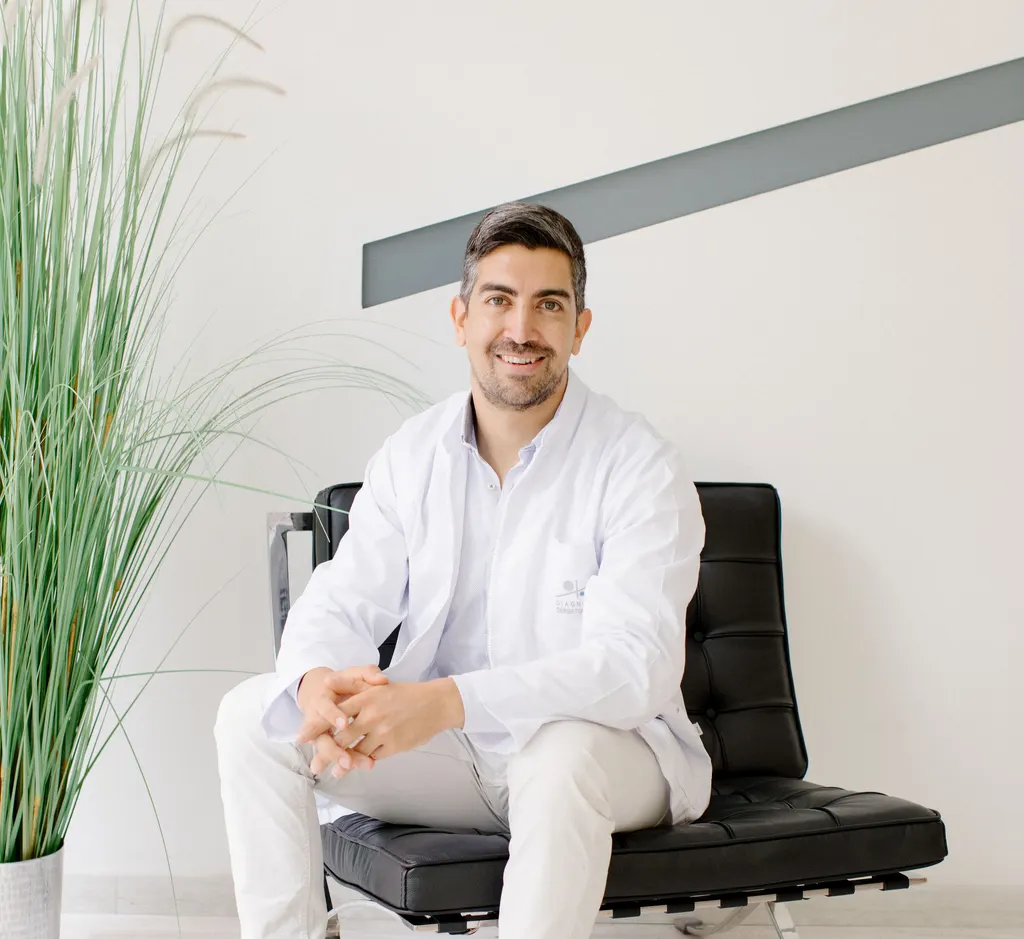
I'm a dermatologist. I look at your spots myself, with dermoscopy, and if they can be treated, I treat them myself. Getting the diagnosis right is what decides whether they fade and whether the treatment is safe.
There are usually two appointments: the assessment first and then, if appropriate, the IPL session.
What spot is this?
You can't tell just by looking
They appear gradually: first one on the cheekbone, then another on the temple, and one day you catch yourself in the mirror looking older than you feel. Almost everyone calls them sun spots, but the same face, at the same age, can have any of these four. They look very alike, and each one is treated differently.

Solar lentigo
Light brown, with a sharp edge, where the sun has hit hardest.
Responds well to IPL.

Seborrhoeic keratosis
Starts out flat and the same colour as a lentigo.
It can be removed, but not with IPL.

Melasma
Diffuse, symmetrical patches that come and go.
IPL can make it worse.

Melanoma
Looks like a sun spot, but keeps changing.
It needs a biopsy. Never treated with light.
And there are hundreds of other kinds of spot, each with its own treatment: freckles, the mark an inflammation leaves as it heals, moles, actinic keratoses, poikiloderma of Civatte, and spots caused by medication or by perfume in the sun.
That's why a diagnosis comes before IPL
Intense pulsed light (IPL) can't tell them apart: it lightens pigment, whatever that pigment belongs to. On a solar lentigo, that's exactly what we want. On melasma it can make it darker, and on a lesion that needed a biopsy it wipes out the very clue that would have made the diagnosis possible. Telling them apart is what I do every day. And because I also have the CO₂ laser and topical treatments, I don't need your spot to be an IPL spot: I'll tell you what it is and what I would do about it.
The assessment
I look at your whole face, not just the spot that worries you
Hardly anyone has just one spot, even if they come in about one. That is why the assessment covers your whole face, in three steps.
I examine your spots with a dermatoscope
One by one. It's what lets me tell a lentigo from a keratosis, and notice the one that doesn't fit either.
I photograph your face under polarised light
It reveals pigment lying beneath the surface that can't yet be seen with the naked eye. That way I know how much sun damage there is and how far it goes, not just what shows on the surface.
I tell you what you have and what I would do
With everything in front of us, we decide what to treat, with what, and in what order. And also what's best left as it is.
The machine shows; I decide. What settles a diagnosis isn't the machine, it's all the faces I've looked at before yours.

The session, when appropriate, is almost always at a separate appointment, and I do it myself. If yours is straightforward and can be dealt with quickly, we sometimes plan it for the same day, but that isn't the norm.
Two IPL cases
This is what one session did for these two patients
A correctly diagnosed solar lentigo responds to IPL, and this is what you see. What you can't see, the underlying damage, is what I talk about just below.


These are two real cases, each after a single session, which is what I recommend. They are not a prediction of your own result: it depends on the type of spot, your skin type and how much sun you get afterwards, and not all spots respond in the same way.
4.9 out of 5
Average rating on Google Maps · 228 reviews
After IPL
The sun you've already had doesn't go away
What you've just seen is the visible part of something that has been building up for years. IPL lightens what you can see, and does it well, but what lies underneath is still there.
They say skin has a memory, and it's fairly literal: every spell in the sun leaves small marks on the DNA of the cells in the epidermis. The body repairs most of them itself, but the ones that aren't repaired stay, and one of the things those cells do is make pigment where it shouldn't. That is the spot you see.
That's why I don't think in terms of one session and done, but of one session a year. It's what has given me the best results: the skin gets better little by little, instead of taking a leap and slipping back.
I do IPL from October to April. After a session the treated skin mustn't get any sun, and in Barcelona, from May to September, that's almost impossible to manage.
The same day
The session is done with cold air on the skin and is well tolerated.
The following days
Fine scabs where the spots were, some redness and, in a few cases, a little swelling. There's no need to take time off work.
After seven days
The scabs have come off and the skin looks normal again.
After a year
A check-up and, if needed, a new session.
Who will see you
Who you'll be showing your face to
I'm a dermatologist and I work in the Melanoma Unit at the Hospital Clínic de Barcelona, where the pigmented lesions that couldn't be resolved elsewhere are referred. I see facial spots every day, of every type, and I've been doing hundreds of IPL sessions a year for years. At the consultation I do the assessment myself, and the session too. And if yours isn't suitable for IPL, I'll tell you, and I'll suggest the right treatment for the type of spot you have.
- Dermatologist · reg. no. 08-49574, COMB
- Melanoma Unit, Hospital Clínic de Barcelona
- More than 100 published papers on melanoma and pigmented lesions
- Hundreds of IPL sessions a year
The assessment is a private, paid first consultation at Diagnosis Dermatológica: Passatge de Ricard Zamora 1, Barcelona.
